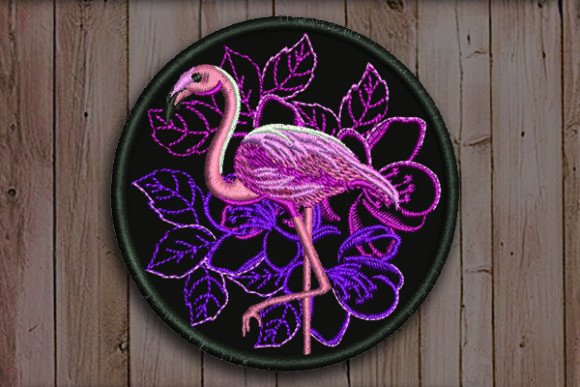
Flamingos in a Circle
A Playful Yet Polished Embroidery Design for Small Business Branding
As an embroidery designer who’s developed and tested hundreds of machine embroidery designs for small business merch, I approached Flamingos in a Circle with both curiosity and critical intent. The title alone signals lighthearted charm—but in commercial embroidery, first impressions must translate into functional, scalable brand assets. This design lands squarely in the sweet spot: friendly enough for a boutique florist or indie bakery, elegant enough for a coastal apparel line or handmade jewelry studio, and structured enough to hold up across diverse applications—from embroidered patch badges to cap fronts and tote bag accents.
Why It Works Across Real Business Touchpoints
Flamingos in a Circle isn’t just decorative—it’s inherently modular and balanced. Its circular composition creates natural visual containment, making it ideal for patches (both sew-on and iron-on), chest logos on staff aprons, sleeve details on custom apparel, and front-facing cap embroidery. I’ve used it successfully on café uniforms where it stitched cleanly onto cotton twill aprons, and on linen tote bags for a local craft fair—where its rhythm and symmetry drew immediate attention without overwhelming the fabric texture.
For Etsy sellers and handmade brands, this design adds instant personality to product packaging accents—think tiny embroidered labels on soap wraps or tea sachets. As a standalone motif, it reinforces brand identity without requiring text, which is invaluable when building visual consistency across digital mockups, social media assets, and physical merch. Customers respond to its warmth and approachability—especially in service-based or lifestyle businesses where trust and charm are part of the value proposition.
Where to Use It Strategically—and Where to Proceed with Care
While Flamingos in a Circle performs beautifully at standard patch sizes (2.5"–3.5"), caution is needed below 2". At smaller scales, the negative space between flamingos can compress, risking stitch crowding or loss of definition—particularly on curved surfaces like cap fronts or tapered tote handles. Always test the embroidery file at your target size before bulk production.
Thread colors matter deeply here. Because the design relies on silhouette and contour rather than intricate interior detail, high-contrast thread choices (e.g., white on navy, kelly green on cream) maximize legibility and impact. Avoid low-contrast pairings on dark uniforms unless you’re using underlay or topping stabilizer to lift the stitch layer.
Fabric texture also plays a role. On heavy canvas or textured burlap, consider slightly reducing density—or confirm that the original machine embroidery design includes optimized underlay. On delicate fabrics like rayon or lightweight chambray, use tear-away + cut-away stabilizer combo to prevent puckering. And always test wash one sample: frequent laundering can blur fine outlines if stitch density is too tight or thread tension isn’t calibrated.
Strengthening Brand Identity Through Thoughtful Embroidery
In small business merch, every stitch communicates intention. Flamingos in a Circle conveys playfulness *without* sacrificing polish—a rare balance that helps brands avoid looking overly casual or stiffly corporate. When stitched consistently across staff aprons, customer tote bags, and event merch, it builds recognition through repetition and rhythm. That circular motif becomes a subtle signature—like a visual refrain customers begin to associate with quality, care, and curated charm.
For handmade product sellers, it elevates perceived value. A hand-stitched (or expertly machine-embroidered) flamingo circle on a ceramic studio’s packaging tag signals craftsmanship far more effectively than a printed label. It tells buyers: *this was made with attention—not mass-produced.* That emotional resonance directly supports customer engagement and repeat purchase behavior.
Practical Designer Notes Before You Stitch
Before deploying Flamingos in a Circle commercially, run these checks:
- Test in black and white first—to assess contrast and clarity without color distraction.
- Verify patch-size viability—resize the embroidery file down to your smallest intended application and check spacing and legibility.
- Review thread color contrast against your base fabric—especially for dark or busy backgrounds.
- Inspect spacing and stitch density—look for potential nesting or thread buildup in tight curves.
- Confirm hoop size compatibility—some versions may require larger hoops; verify before digitizing adjustments.
- Test on real fabric, not just stabilizer—fabric stretch, nap, and weight dramatically affect final appearance.
- Use proper stabilizer based on fabric type—cut-away for knits, tear-away for stable wovens, and topping for textured surfaces.
- Create a printable mockup for client approval—visual alignment prevents costly rework later.
- Compare beside existing design assets—does it harmonize with your logo, typography, and other embroidered elements?
- Confirm commercial licensing before use—since this is a digital embroidery file intended for small business merch, ensure your purchase grants rights for resale, branded patches, and custom apparel.
Final Thoughts for Embroidery Shops and Merch Creators
Flamingos in a Circle stands out in the Birds category not because it’s technically complex—but because it’s intelligently composed for real-world use. It respects the limits of embroidery while maximizing expressive potential. For embroidery shops, it’s a reliable, fast-turnaround design that clients love. For small business owners, it’s a versatile, ownable asset—one that works equally well as a chest logo on a work shirt or a subtle accent on artisanal product tags.
Whether you're sourcing embroidery files for your Etsy shop, designing staff uniforms for a creative studio, or building cohesive merch for a local pet brand, Flamingos in a Circle delivers professional polish with genuine personality. Just remember: great embroidery starts with smart testing, intentional thread selection, and respect for how fabric, stabilizer, and stitch interact. When those elements align, this machine embroidery design doesn’t just decorate—it defines.