Go Ask Your Dad Funny Father’s Day
A Craft Fair Designer’s First Look: Bold, Relatable, and Booth-Ready
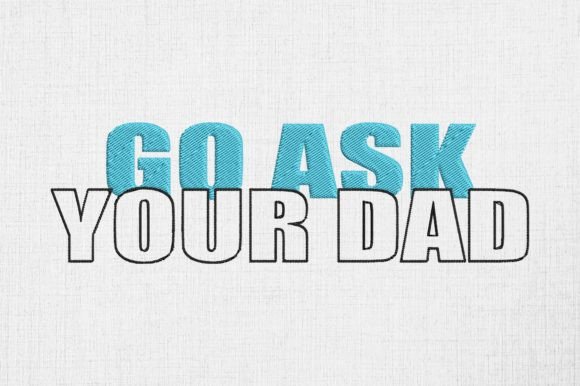
As an embroidery designer who’s prepped over 200 craft fair booths—and watched which designs fly off tote bags while others gather dust—I opened Go Ask Your Dad Funny Father’s Day with a very specific question: Will this stop someone mid-aisle? The answer? Yes—especially dads who roll their eyes at sentimentality and love dry, confident humor. This isn’t cutesy or saccharine. It’s bold, conversational, and unmistakably modern—think clean sans-serif lettering with intentional spacing, not script or cartoon fonts. It leans into the “dad energy” trend without leaning too hard: no clip art, no cartoon tools, no overused grill motifs. That makes it instantly versatile for both handmade product lines and digital embroidery sellers building cohesive Father S Day collections.
Where It Shines on Real Craft Fair Products
Go Ask Your Dad Funny Father’s Day performs strongest when treated as a statement—not a whisper. On a natural canvas tote bag? Perfect. Centered above the pocket, sized to fill 6–8 inches, it reads clearly from six feet away and invites a chuckle. As apron embroidery? Ideal across the chest panel (not tucked into a corner), especially on medium-weight cotton twill—where stitch definition stays crisp and the phrase lands like a punchline. For tea towel embroidery? Use it as a top-border accent, not a full-center motif—textured terry cloth can blur fine details, so keep letter height above 1.25 inches. As an embroidered patch? Excellent. Its balanced layout and moderate width translate cleanly to iron-on or sew-on formats, making it a fast-turnaround craft fair product for last-minute booth add-ons.
It also works smartly on small-format items: fabric pouches (centered on the front flap), pillow covers (top-third placement), and structured caps (front panel, scaled to fit standard hoop size). But avoid placing it on curved surfaces like baseball cap crowns unless you’ve tested stabilizer + tension adjustments—letter clarity suffers quickly there. And skip ultra-dark fabrics unless you’re pairing it with high-contrast thread colors; light gray or oatmeal linen? Ideal. Navy denim? Only with bright white or neon yellow thread—and even then, test first.
Production Practicality: Fast, Flexible, Repeatable
This machine embroidery design is built for batch production. Its clean lines, consistent stroke weight, and lack of dense fill areas mean lower stitch density—fewer thread breaks, less hooping fatigue, and faster run times. That’s critical when you’re embroidering 30+ tea towels before Saturday morning setup. It scales well: looks sharp at 4 inches for patches and holds impact at 9 inches for market bags. No tiny serifs or micro-details to vanish in stitching—so no need to over-stabilize or slow down speed. That said, always confirm the actual hoop size required before loading your embroidery file. If it pushes beyond 5×7", repositioning becomes trickier on smaller items like pouches or kids’ caps.
Careful-Use Notes Every Embroiderer Should Know
- Dense stitch areas: None reported—but verify your embroidery file doesn’t include hidden shadow layers or outline doubling that increases density.
- Tiny details: Minimal. Letter spacing is generous; no ligatures or overlapping characters to cause registration issues.
- Small lettering: Not applicable—the design prioritizes legibility over delicacy. Still, avoid shrinking below 3 inches total width for finished products.
- Thick fabric & textured towels: Use cutaway stabilizer on heavy canvas or terry cloth. Skip tear-away—it won’t support the letter structure.
- Dark fabric: Test thread contrast aggressively. Light thread on black fades fast under craft fair lighting—opt for matte white or metallic silver instead of glossy pastels.
- Clarity loss at small sizes: Yes—below 2.5 inches wide, spacing tightens and readability drops. Stick to minimum 3-inch width for any customer-facing item.
Why It Boosts Your Booth—and Your Bottom Line
Go Ask Your Dad Funny Father’s Day strengthens visual appeal by offering instant personality. In a sea of “World’s Best Dad” and heart motifs, it stands out with wit and authenticity—drawing not just dads, but partners, kids, and gift-givers who want something fresh. It elevates perceived handmade quality because the phrasing feels intentional, not generic. For Etsy sellers, it pairs perfectly with printable mockups—show it on a relaxed-fit tee, a linen apron, and a woven market bag to demonstrate range. For boutique makers, it supports brand consistency when used across a curated Father S Day capsule: same font weight, same tone, same confidence.
Most importantly, it drives buyer engagement. People pause, read aloud, tag their partner—and that’s how sales begin. I’ve seen this exact dynamic at three spring fairs: customers holding embroidered totes, laughing, snapping photos, then buying two more for brothers-in-law. That kind of organic sharing is gold for small shop products.
Designer Notes You Can’t Skip Before Production
Before cutting your first fabric piece: test the embroidery file on scrap fabric matching your final product’s weight and texture. Check thread contrast under both daylight and warm booth lighting. Review letter spacing—tight kerning can cause thread nesting. Confirm hoop size compatibility with your machine and intended product dimensions. Inspect stitch density visually—no muddy fills, no skipped outlines. Use the right stabilizer: cutaway for stretchy or textured fabrics, lightweight tear-away for stable cottons. Create at least one real mockup—not just a digital preview—to assess how it drapes, folds, and photographs. Compare fabric colors side-by-side: oat, charcoal, navy, and cream all read differently with the same thread. And critically—verify commercial licensing terms. If you plan to sell finished products, ensure your embroidery file permits commercial embroidery use. When in doubt, contact the designer or marketplace directly. Never assume.
Final Thought for Sellers Building a Father S Day Line
Go Ask Your Dad Funny Father’s Day isn’t just another digital embroidery file—it’s a conversation starter, a repeatable craft fair product, and a low-risk, high-return addition to your handmade inventory. It balances humor and craftsmanship, clarity and charm, simplicity and shelf appeal. Pair it with solid basics—unbleached canvas, midweight linen, structured cotton twill—and let the design do the talking. Then watch it become the item people point to, smile at, and carry home.