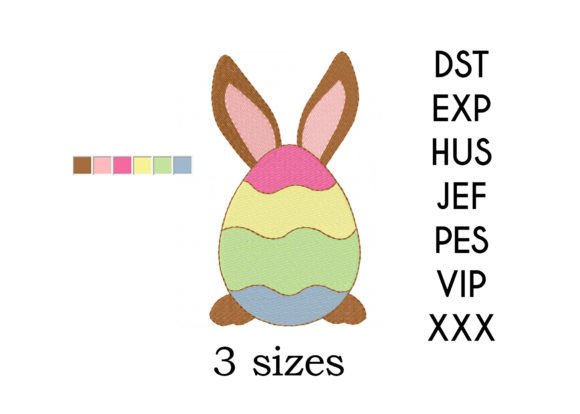
Large Bunny Embroidery Design Review
A Friendly, Festive Asset for Small Business Branding
As an embroidery designer who’s developed hundreds of commercial designs for cafés, boutiques, bakeries, florists, and pet brands, my first impression of Large Bunny is strongly positive: it reads as cheerful, approachable, and intentionally festive—not overly cutesy or juvenile. The phrase “colorful and pretty” in its description signals a balanced palette and clean visual hierarchy, which translates well into professional small business merch. It leans into warmth and celebration without sacrificing polish—ideal for brands that want to feel handmade yet trustworthy.
Real-World Performance Across Merchandise Types
Large Bunny shines brightest as an embroidered patch, chest logo accent, or sleeve detail on staff uniforms and aprons. Its scale and clarity make it highly legible at 3–4 inches tall—a sweet spot for café aprons, bakery smocks, or florist vests. On tote bags and reusable market sacks, it anchors the design with charm and seasonal relevance while reinforcing brand identity through consistent visual storytelling. As cap embroidery, it works best on structured front panels (not curved visors) where stitch definition holds. For custom apparel like work shirts or kids’ smocks, it adds personality without overwhelming the garment.
When used on product packaging accents—think stitched labels on gift boxes, linen tea bags, or seed packet tags—Large Bunny elevates perceived value. It supports a handmade product narrative without looking amateurish, especially when paired with neutral backgrounds and quality thread colors. Etsy sellers and craft studios report stronger buyer engagement when this kind of intentional, holiday-aligned embroidery appears on listing mockups and physical packaging. As part of a broader set of design assets, Large Bunny helps unify Easter-themed collections while maintaining brand voice.
Where to Use Large Bunny With Intention
Because Large Bunny is described as “large,” it’s not optimized out-of-the-box for tiny applications. Avoid using it below 2 inches tall—especially for embroidered patches meant for lapel pins, keychains, or miniature product tags—without testing first. Cap fronts with tight curvature may distort fine details; always test on a real cap blank before bulk production. On dark uniforms or textured fabrics like canvas tote bags or heavy twill aprons, confirm that stitch density and thread color contrast are sufficient for readability after washing.
High stitch density isn’t mentioned in the description, but the phrase “machine embroidery and applique files” suggests layered construction. That means stabilizer choice becomes critical—especially for lightweight cottons or knits used in boutique merchandise. Also, avoid placing Large Bunny near seams, hems, or stretch zones unless you’ve verified hoop stability and fabric behavior during stitching.
How Large Bunny Strengthens Brand Identity
For small businesses, consistency is credibility—and Large Bunny delivers visual continuity across touchpoints. When stitched on staff aprons, customer totes, and seasonal product labels, it creates subconscious recognition. Customers begin associating that friendly bunny shape with your brand’s warmth and attention to detail. That builds trust faster than generic clip art ever could.
Unlike mass-produced graphics, a well-executed Large Bunny embroidery file signals craftsmanship and intention. It tells customers you invest in quality finishes—even for seasonal items. That perception lifts perceived product value, supports premium pricing, and differentiates your offerings from competitors relying solely on print-on-demand. For handmade brands and creative studios, it reinforces authenticity while keeping Easter messaging joyful and inclusive—not overly religious or commercialized.
Practical Designer Notes Before You Stitch
Before launching Large Bunny into production, follow these field-tested steps:
- Test in black and white first—verify outline clarity and negative space balance without color distraction.
- Check small patch viability—resize to 2 inches and run a test stitch on your target fabric to assess detail retention.
- Review thread color contrast—especially if embroidering on dark or busy-patterned textiles common in boutique merchandise.
- Inspect spacing between elements—applique layers need breathing room to prevent puckering on curved surfaces like caps or sleeves.
- Confirm hoop size compatibility—“large” implies it may require a 5x7" or larger hoop; verify before digitizing adjustments.
- Test on real fabric—not just stabilizer swatches—particularly for high-wash items like aprons or staff uniforms.
- Use proper stabilizer—cut-away for knits, tear-away for stable wovens, and fusible for lightweight linens used in tote bag design.
- Create a printable mockup for client approval—show how Large Bunny integrates with existing branding, fonts, and layout.
- Compare beside other design assets—ensure visual weight and style align with your current logo, icons, and seasonal collections.
- Confirm commercial licensing—this is essential before using Large Bunny on products sold to end customers, especially for Etsy sellers and wholesale partners.
Final Thoughts for Embroidery Shops and Creative Businesses
Large Bunny isn’t just another Easter embroidery file—it’s a versatile, brand-forward machine embroidery design built for real business use. Whether you’re stitching it on a florist’s canvas tote, a pet brand’s staff cap, or a bakery’s limited-edition apron line, it brings cohesion, charm, and seasonal relevance without compromising professionalism. For embroidery shops, it’s a reliable upsell for clients launching spring campaigns. For small business owners, it’s a low-risk, high-impact way to refresh visual identity with purpose.
Just remember: great embroidery starts with smart prep—not just beautiful files. Treat Large Bunny like any other core design asset: test rigorously, integrate thoughtfully, and always prioritize how it serves your brand’s story—and your customers’ experience.